.svg)



Executive Summary
A leading global streaming media company, operating multiple premium streaming platforms serving millions of subscribers worldwide, transformed its content delivery infrastructure by migrating from legacy object storage to MinIO's high-performance AIStor platform. Managing one of the world's largest entertainment content libraries, the company needed an S3-compatible solution that could deliver broadcast-quality video with minimal latency while scaling to handle petabytes of live and on-demand content.
Within 18 months, the streaming provider deployed AIStor across 10+ global data centers, handling massive workloads including premium VOD origin serving, multi-brand content delivery, live sports streaming, and international service platforms. The migration eliminated metadata bottlenecks that plagued their previous system, dramatically improved time-to-first-byte (TTFB) performance, and enabled rapid cluster deployments that previously took months.
The Environment
This global streaming media company operates one of the world's largest entertainment technology platforms, delivering content to subscribers across multiple premium streaming brands spanning entertainment, sports, and international markets. Behind the scenes, this requires a sophisticated multi-region infrastructure capable of:
- Storing and serving petabytes of video streaming content across hot and warm tiers
- Supporting live-to-VOD workflows for sports and live events with minimal latency
- Handling millions of concurrent requests during peak viewing times
- Leveraging both public cloud and on-premise datacenters to maintain geographic redundancy across North America, Europe, South America, and Asia
As streaming viewership accelerated and content libraries expanded, the infrastructure team faced mounting pressure to scale efficiently while maintaining the performance standards viewers expect.
Challenges
While their public cloud provider was able to support these requirements, the legacy on-premises object storage solution faced numerous challenges:
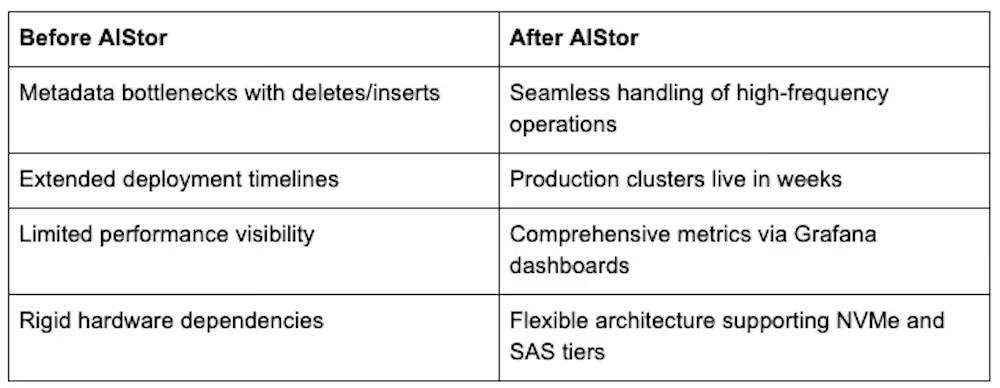
- Metadata Store Limitations: The legacy object storage system struggled with high-frequency deletes and inserts, creating real-time performance operational bottlenecks and data consistency issues which impacted customer experience. "The metadata store has trouble with lots of deletes and inserts. These scale and consistency issues were one of the biggest reasons we needed to explore alternatives."
- Performance Challenges: The previous solution struggled to meet the Live-to-VOD workflows’ demand for consistently low TTFB and high throughput, especially when small playlist files were being constantly overwritten during live events. AIStor significantly reduced TTFB and was able to handle traffic spikes seamlessly. Additionally,
- Hardware Reliability Issues: A diverse legacy hardware footprint caused numerous hardware failures, which drove up costs and delayed go-live timelines for new services.
- Geographic Complexity: A fragmented global footprint of outdated technology and dependence on legacy systems created significant and difficult technical debt. This lack of uniformity and reliability directly slowed down the modernization effort and the ability to roll out new services on a cohesive platform.
The Vision
The streaming company's infrastructure team envisioned a next-generation on-premises storage platform delivering:
- Scalability at Speed: Ability to deploy multi-petabyte clusters in weeks, not months
- Predictable Performance: Consistent low-latency access regardless of workload or content tier
- Operational Simplicity: Reduced maintenance overhead with reliable automation
- Cost Efficiency: Optimized use of data center resources with intelligent tiering
- API Consistency: Full, 100% compatibility with S3 API to ensure seamless operation across public cloud and on-premises
The Solution: AIStor
Faced with these challenges, the streaming provider selected MinIO’s AIStor to replace its’ legacy on-premises object storage,
Multi-Tier Architecture: The streaming provider was able to use AIStor’s built in Information Lifecycle Management (ILM) capabilities to store data in both hot (NVMe) and warm (SAS) storage tiers, optimizing cost and performance across content lifecycles.
MinIO AIStor Architecture
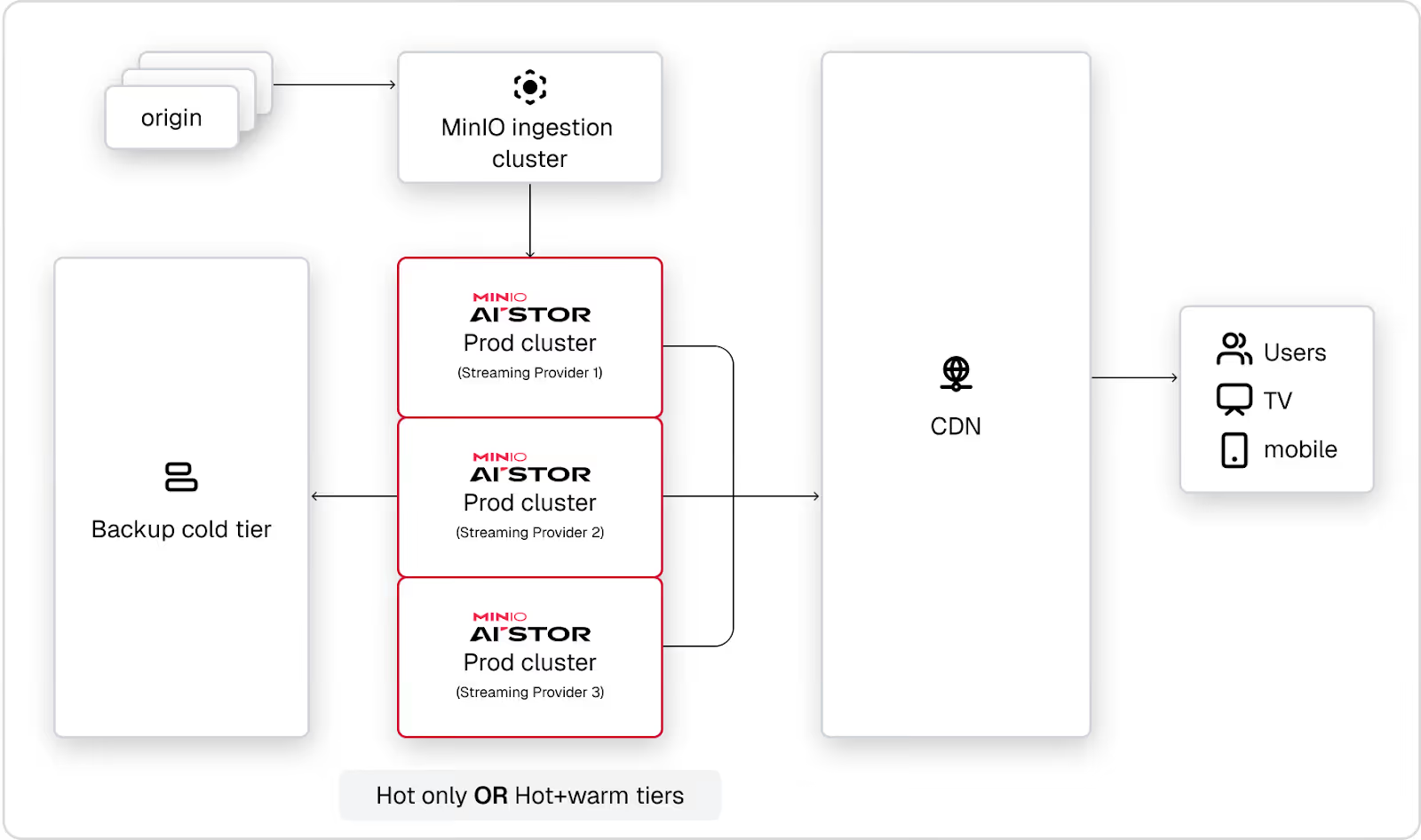
Global Deployment: AIStor clusters deployed across multiple strategic locations in North America, South America, Europe, and Asia, each tuned for regional workload patterns.
Purpose-Built Clusters: Separate AIStor deployments optimized for specific use cases:
- Premium entertainment VOD origin serving
- Sports and live event streaming workflows
- Content staging and processing pipelines
- Media repository for raw files and mezzanine content
- Observability infrastructure for logging and metrics
Rapid Iteration: Ability to bring up object storage clusters and move to production at unprecedented speed, enabling faster business decisions.

Results & Outcomes
"We are going to move much faster with the migration because our legacy system cannot deliver"
Business Impact:
- 3x Traffic Handling: Successfully managed traffic spikes during CDN issues without service degradation, maintaining 11ms average response time
- Faster Time to Market: Reduced cluster deployment time from months to weeks, accelerating new service launches
- Enhanced Reliability: Successfully migrated international live streaming platform to production, replacing problematic legacy system
- Geographic Expansion: Enabled rapid international expansion including South American and European markets
- Operational Efficiency: Moved from 6-9 month hardware refresh cycles to agile software-defined deployments
"When our traffic tripled because of a CDN issue, AIStor didn't miss a beat."
Technical Achievements:
- Performance: Achieved target 150-200Gbps egress on optimized NVMe clusters
- Scale: Deployed 64-128 node clusters handling 84PB+ usable capacity for cloud DVR services alone
- Density: Migrated to 2U nodes with 30TB NVMe drives, maximizing data center space utilization
Unexpected Wins
Engineer-to-Engineer Support: The streaming platform's team gained direct access to AIStor engineers through Subnet, enabling rapid troubleshooting and feature development collaboration. Issues that might take weeks with traditional vendors were resolved in days or hours.
Training at Scale: MinIO provided comprehensive training for the expanding engineering team, including multi-week sessions for new engineering groups as the organization scaled.
Looking Forward
The streaming media company continues to expand its AIStor deployment with plans for:
- Focus on all-flash clusters for streaming and live-to-VOD workflows
- Migration of remaining legacy workloads including live linear streaming
- Enhanced tagging and cataloging capabilities for multi-brand content attribution
- Continued geographic expansion supporting global subscriber growth
.svg)


.avif)